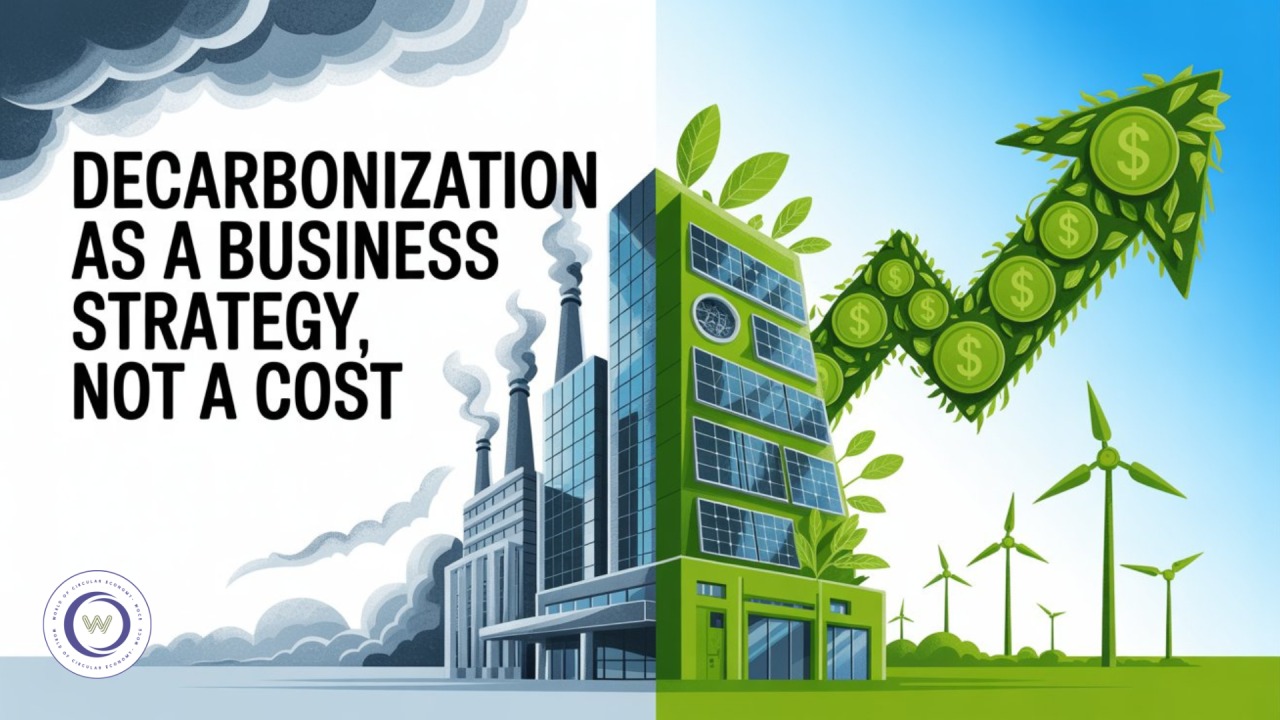
Decarbonization as a Business Strategy
Not a Cost
04 November, 2025
WOCE Team
Why forward-thinking companies are treating carbon reduction as their most valuable investment and leaving competitors behind.
Reframe the Narrative: From Cost Centre to Growth Driver
For too long, businesses have viewed decarbonization through the narrow lens of expense. Yet the world's leading companies tell a dramatically different story: they treat carbon reduction as a strategic investment in resilience, competitiveness, and innovation.
The numbers speak for themselves. Reducing emissions unlocks operational efficiencies that directly impact the bottom line. Lower long-term energy costs and improved resource productivity create sustained competitive advantages that compound over time.
But here's what the "cost mindset" dangerously overlooks: the hidden risks of inaction. Rising carbon taxes aren't hypothetical anymore. They're real, expanding, and increasingly expensive. The EU's Carbon Border Adjustment Mechanism (CBAM) will impose tariffs on high-carbon imports starting 2026. India's Carbon Credit Trading Scheme is creating market-based carbon pricing. Companies that treat decarbonization as optional spending are actually accumulating invisible liabilities that will crystallize as mandatory costs, often at the worst possible time.
Investor withdrawal represents another overlooked risk. As ESG integration deepens, capital is flowing away from high-carbon businesses toward climate-ready alternatives. The cost of capital gap between leaders and laggards is widening quarterly. What looks like savings today becomes a competitive disadvantage tomorrow.
Investor and Market Signals Are Shifting
The investment landscape has fundamentally transformed. Global investors are no longer treating ESG performance as a feel-good add-on. They're embedding it directly into capital allocation decisions, rewarding low-carbon leaders with cheaper access to capital and punishing laggards with higher costs or outright exclusion.
The mechanisms are diverse and growing. Sustainability-linked loans tie interest rates to emissions performance. Green bonds offer preferential terms for climate-positive projects. Private equity funds increasingly screen for carbon risk before investment decisions.
This isn't just about environmental virtue. For investors, decarbonization serves as a proxy for broader business quality: governance effectiveness, risk management sophistication, and future readiness. A company that can't manage its carbon footprint raises questions about its ability to navigate other complex operational challenges. Conversely, companies aligning with net-zero pathways signal strategic capability and long-term thinking that attracts patient capital.
The trajectory is clear. As climate risks materialize and regulations tighten, this capital allocation shift will accelerate. Companies positioned as decarbonization leaders gain sustained access to growth capital. Those lagging face a shrinking pool of increasingly expensive funding.
Regulation Is Converging and It is Costlier to Delay
Regulatory frameworks across major economies are converging on a single message: carbon accountability is becoming mandatory, comprehensive, and enforced. The voluntary era is ending.
The EU's CBAM exemplifies this shift. Starting 2026, importers must purchase certificates matching the carbon content of steel, cement, aluminum, fertilizers, and hydrogen imports. For exporters to Europe, decarbonization isn't an environmental choice, it's literally the price of market access. Indian and Chinese manufacturers are already investing billions in low-carbon production not from altruism, but from economic necessity.
India's own Carbon Credit Trading Scheme launched in 2023 establishes domestic carbon pricing that will expand in scope and stringency. The Corporate Sustainability Reporting Directive (CSRD) requires detailed climate disclosure from 50,000 companies operating in Europe. These are not isolated initiatives but parts of a global regulatory convergence making carbon management mandatory for competitiveness.
The economic logic strongly favors prompt action. Companies adapting operations and supply chains ahead of mandates spread costs over time, integrate changes smoothly, and often discover efficiency gains that offset investments. Laggards face steep retrofitting costs, rushed compliance efforts, and potential non-compliance penalties. The later you move, the more expensive and disruptive the transition becomes.
Compliance is no longer optional. It's integral to market access, and the companies treating it as strategic priority gain substantial first-mover advantages.
Operational Efficiency and Innovation
Here's where the strategic value of decarbonization becomes undeniable: carbon reduction inherently drives operational improvement. The same investments that cut emissions typically deliver multiple business benefits simultaneously.
Energy efficiency measures reduce carbon while cutting operating costs. When IKEA invested €2.5 billion in renewable energy, they didn't just reduce emissions; they slashed energy bills by 40% and now generate excess electricity they sell back to grids for additional revenue. The "cost" became a profit center.
Process innovation accelerates under carbon constraints. When you challenge engineers to deliver the same output with half the emissions, they can't just tweak existing systems. They must fundamentally rethink production methods. This creative pressure consistently produces innovations that improve efficiency, quality, and performance beyond just carbon metrics.
Renewable energy adoption provides cost stability against volatile fossil fuel markets. Companies locked into fossil-dependent operations face exposure to price spikes and supply disruptions. Those powered by renewables enjoy predictable, increasingly cheap energy that hedges against geopolitical and market volatility.
Electrification of processes, circular economy models that minimize waste, and digital optimization that reduces resource consumption all deliver carbon reduction and operational improvement together. The strategic question isn't whether to invest in decarbonization but how quickly you can capture the efficiency gains it enables.
Competitive Differentiation and Brand Value
Consumer and business buyer behavior is shifting measurably toward low-carbon preference. This isn't just survey sentiment; it's showing up in purchasing decisions and brand valuations.
Unilever's sustainable brands portfolio grew 69% faster than the rest of their business and delivered 75% of company growth. These products command price premiums while building customer loyalty that insulates against competitive pressure. The market is voting with wallets for demonstrable sustainability.
B2B dynamics mirror consumer trends. Major corporate buyers from Apple to Walmart now require supplier decarbonization. When Apple announces carbon-neutral products, every component supplier must reduce emissions or risk losing contracts worth billions. Procurement decisions increasingly favor low-carbon vendors, turning sustainability into a competitive qualifier.
Demonstrating measurable decarbonization builds trust and brand equity. Transparent reporting of emissions reductions, verified through credible platforms, transforms compliance data into marketing assets. Carbon-neutral certifications from recognized bodies provide third-party validation that resonates with stakeholders.
The brand value extends beyond customers to employees, investors, and communities. Companies with credible climate action attract better talent, enjoy stronger community relations, and build reputational resilience against potential controversies. In an age of social media and activist investors, brand strength increasingly depends on authentic sustainability performance.
Supply Chain Transformation
Scope 3 emissions, the carbon embedded in supply chains, typically represent upto 70% of a company's total footprint. This reality is driving unprecedented supply chain collaboration and transformation.
Decarbonizing suppliers creates leaner, more resilient value chains. Companies engaging suppliers on emissions data discover inefficiencies, risks, and improvement opportunities they'd never identified before. The carbon lens reveals supply chain vulnerabilities and optimization possibilities.
Digital tools are making this collaboration practical. Platforms that simplify carbon data collection from thousands of suppliers turn an overwhelming task into manageable process. Suppliers gain visibility into their own emissions, buyers gain data for informed procurement decisions, and both parties identify mutual opportunities for improvement.
Green procurement is rapidly moving from "nice-to-have" to qualifying criterion. Major tenders increasingly require carbon data as part of bid submissions. Trade contracts specify maximum carbon intensity for supplied goods. Companies without supply chain decarbonization capability face growing exclusion from valuable contracts and customer relationships.
The transformation extends beyond immediate suppliers. Leading companies are working multiple tiers deep into supply chains, recognizing that comprehensive decarbonization requires system-level change. This collaboration builds relationships, shares knowledge, and creates competitive advantages that extend far beyond carbon metrics.
Workforce and Culture Shift
Embedding decarbonization into corporate DNA catalyzes cultural transformation that drives innovation and engagement across organizations.
The talent advantage is substantial. Younger workers who will dominate the workforce by 2030 overwhelmingly prioritize working for companies aligned with their values. A 2024 Deloitte study found 49% of Gen Z candidates rejected job offers from companies with poor sustainability records, even when compensation was competitive.
Beyond recruitment, sustainability-driven culture fosters innovation and purpose. When employees see their work contributing to meaningful climate goals, engagement and creativity increase. Teams empowered to identify decarbonization opportunities often discover process improvements and innovations management would never have found alone.
Internal carbon pricing and green KPIs make sustainability tangible and accountable. When business units face explicit carbon costs in their budgets, behavior changes. When managers have emissions reduction targets alongside traditional performance metrics, climate becomes integrated into daily decision-making rather than a separate corporate responsibility function.
This cultural shift creates organizations that are adaptive, innovative, and future-ready. The companies building climate-conscious cultures today are developing competitive advantages that extend far beyond carbon reduction itself.
Long-Term Risk Mitigation
Climate change creates three distinct risk categories for business: physical, transition, and reputational. Strategic decarbonization mitigates all three simultaneously.
Physical risks are already disrupting operations globally. Heat waves shut down factories. Droughts constrain water-intensive production. Extreme weather disrupts logistics networks. These impacts are increasing in frequency and severity. Companies that decarbonize typically also build resilience against physical climate impacts through diversified energy sources, reduced resource dependence, and adaptive capacity.
Transition risks stem from the shift to a low-carbon economy. Carbon pricing expansion, regulatory tightening, technology disruption, and market preference changes all threaten business models built on high-carbon operations. Companies decarbonizing proactively navigate these transitions smoothly while laggards face abrupt, costly adjustments.
Reputational risks can materialize suddenly and devastatingly. In an era of social media scrutiny and activist investors, being caught unprepared on climate creates brand damage that's difficult and expensive to repair. Companies demonstrating authentic climate action build reputational resilience.
Think of decarbonization as insurance against business disruption. The investment hedges against carbon price volatility, supply chain disruptions, regulatory penalties, and stakeholder backlash. It's not an expense but a systematic approach to reducing existential risks to business continuity and competitiveness.
The Digital Advantage: Data-Driven Decarbonization
The complexity of decarbonization across operations, supply chains, and product lifecycles demands sophisticated data management and analysis. This is where digital transformation meets climate strategy.
Modern sustainability platforms make decarbonization measurable, transparent, and actionable. Real-time emissions tracking provides visibility that was impossible with manual spreadsheets and annual reports. When management can see carbon impacts of operational decisions immediately, they can optimize continuously rather than retrospectively.
Decarbonization roadmaps built on robust data identify highest-impact opportunities and track progress against targets. Integration with financial systems allows direct comparison of carbon reduction investments against returns. Scenario modeling tests different strategies before committing resources.
Carbon management tools that integrate offsetting marketplaces, supplier collaboration platforms, and regulatory reporting streamlines what would otherwise be overwhelming complexity. Digital infrastructure turns sustainability from a compliance burden into a strategic, data-driven decision system that identifies opportunities and drives performance.
Tools like WOCE's ESG and Carbon Management platforms exemplify this digital advantage. By consolidating emissions tracking, regulatory reporting, supplier engagement, and offsetting into unified systems, they make comprehensive decarbonization practical for organizations of any size. The technology exists today to transform climate strategy from aspiration to execution.
The Bottom Line
The fundamental question has shifted. It's no longer "Can we afford decarbonization?" It's "Can we afford not to?"
The business case is overwhelming and growing stronger. Decarbonization reduces costs through efficiency, opens market access, attracts capital on favorable terms, builds brand value, secures talent, and mitigates existential risks. Companies treating it as strategic investment are capturing compounding advantages across multiple dimensions of business performance.
The companies treating decarbonization as optional expense or distant concern are accumulating hidden liabilities while watching competitors pull ahead. The cost of delay compounds: regulatory compliance becomes more expensive, market access shrinks, capital costs rise, talent becomes harder to attract, and strategic options narrow.
Treating decarbonization as core business strategy ensures profitability, resilience, and relevance in a rapidly changing global economy. It's not about sacrifice or burden. It's about building competitive advantages that translate directly to shareholder value while contributing to planetary sustainability.
The transition to a low-carbon economy is inevitable, driven by physics, policy, and markets. The only question is whether your company will lead it, follow it, or be disrupted by it. The companies figuring this out today won't just survive the transition. They'll thrive in it, building enduring business value while building a sustainable future.