Sustainability Reporting
Is Becoming Financial Reporting
12 November, 2025
WOCE Team
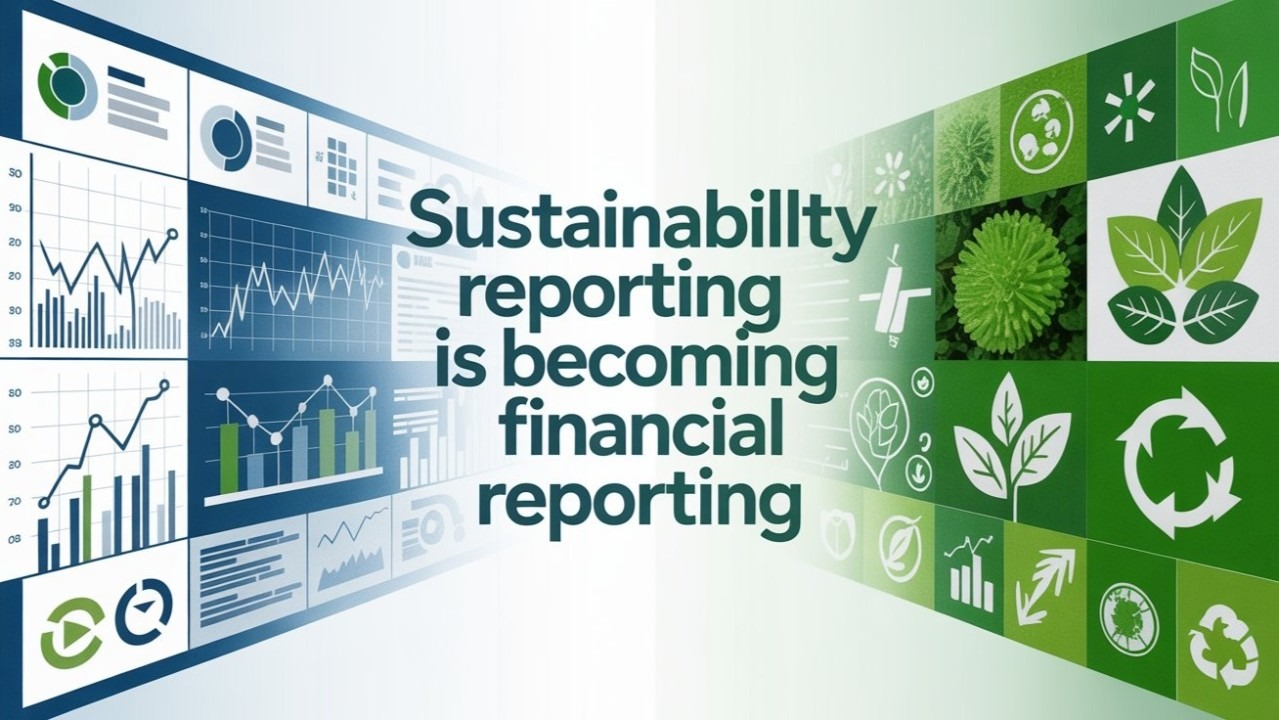
Why carbon data is joining revenue and profit as the metrics that determine company value and why non-financial disclosure now matters as much as your balance sheet.
There's a quiet revolution happening in corporate reporting rooms across the globe. CFOs who once viewed sustainability reports as marketing collateral for the corporate responsibility team are now treating carbon data with the same rigor they apply to quarterly earnings. Investors who used to skim ESG disclosures are now analyzing them line by line before making capital allocation decisions. Auditors trained in financial accounting are scrambling to build expertise in emissions verification.
The boundary between financial and non-financial reporting isn't just blurring. It's disappearing entirely.
This isn't about corporate virtue or environmental activism. It's about a fundamental shift in how markets assess company value, risk, and future performance. Sustainability reporting is becoming financial reporting because investors have recognized an uncomfortable truth: the traditional financial statements tell an increasingly incomplete story about a company's health and prospects.
The Great Convergence: When ESG Meets GAAP
For decades, corporate disclosure operated in two parallel universes. Financial reporting followed strict standards, faced mandatory audits, and determined stock prices and credit ratings. Sustainability reporting remained voluntary, varied wildly in quality and scope, and occupied a separate section of annual reports that many investors never read.
That separation is collapsing at remarkable speed.
The catalyst isn't idealism but pragmatism. Major investors managing trillions in assets have concluded that carbon emissions, water usage, supply chain labor practices, and governance quality directly impact financial performance in ways traditional accounting doesn't capture. A company's carbon footprint isn't just an environmental concern. It's a financial liability waiting to materialize as carbon taxes, stranded assets, regulatory penalties, and lost market share.
The regulatory environment is accelerating this convergence. The EU's Corporate Sustainability Reporting Directive (CSRD) requires sustainability information to receive the same audit assurance as financial statements. The International Sustainability Standards Board (ISSB) deliberately mirrors financial reporting standards to ensure sustainability disclosure achieves comparable rigor and reliability. India's Business Responsibility and Sustainability Reporting (BRSR) makes detailed ESG disclosure mandatory for top listed companies.
We're witnessing the merger of two reporting streams into a single, integrated disclosure framework where carbon data sits alongside cash flow, and governance metrics matter as much as profit margins.
Investors Are Reading the Carbon Balance Sheet
The investment community's transformation in how it values sustainability data represents one of the most significant shifts in capital markets in decades.
BlackRock, the world's largest asset manager with over $10 trillion under management, now requires all portfolio companies to disclose climate risks and demonstrate progress toward net-zero pathways. This isn't a request. Companies that fail to provide credible sustainability data face divestment or engagement campaigns that can tank stock prices.
Activist investors are wielding sustainability data as ammunition. Shareholder resolutions demanding climate disclosure and emissions reduction targets are passing with majority support, even against management recommendations. When a major oil company faced a successful shareholder rebellion over climate strategy in 2021, it signaled a permanent shift in investor power dynamics.
The mechanisms connecting sustainability to valuation are becoming more sophisticated. Investors now use carbon intensity ratios, Scope 3 emissions trends, renewable energy percentages, and water efficiency metrics as predictive indicators of operational excellence, risk management quality, and future-readiness. Companies outperforming on these metrics consistently receive valuation premiums, while laggards trade at discounts.
This isn't future-thinking anymore. It's happening now. The market is pricing sustainability performance into stock values, and the correlation is strengthening quarterly.
Non-Financial Disclosure: The New Balance Sheet
Traditional balance sheets capture assets, liabilities, and equity at a point in time. They're backwards-looking snapshots of financial position. Sustainability reporting, when done properly, reveals forward-looking information that financial statements miss entirely.
Carbon emissions disclose exposure to transition risks as economies decarbonize. A cement manufacturer with high carbon intensity faces future costs from carbon pricing, potential asset stranding, and competitive disadvantage against low-carbon alternatives. This risk doesn't appear on traditional balance sheets until it materializes as losses, but it exists today and affects company value.
Water usage reveals operational vulnerability. A semiconductor fab consuming vast water resources in a drought-prone region faces production risk that financial statements won't show until water shortages actually halt operations. Sustainability disclosure makes this risk visible to investors before crisis hits.
Supply chain labor practices indicate management quality and reputational risk. Companies with poor supplier oversight face potential scandals, boycotts, and regulatory action. These risks lurk invisibly in financial statements but become apparent through comprehensive ESG disclosure.
Governance metrics predict long-term performance and scandal risk. Board diversity, executive compensation structures, anti-corruption programs, and stakeholder engagement quality all correlate with sustainable value creation. Investors increasingly view strong governance as predictive of financial outperformance.
The analogy is direct: if financial statements are the rearview mirror showing where you've been, sustainability disclosure is the windshield showing where you're headed. Smart investors want both views.
The Regulatory Tsunami: Mandatory Integration
Regulatory momentum toward integrated financial and sustainability reporting is building into an unstoppable force reshaping global corporate disclosure.
The EU's CSRD affects approximately 50,000 companies and requires double materiality reporting. Companies must disclose how they impact the environment and society (impact materiality) and how sustainability issues affect financial performance (financial materiality). This framework explicitly connects ESG to financial outcomes.
Critically, CSRD mandates independent assurance of sustainability information at the same level required for financial statements. Auditors must verify carbon data with the same rigor they apply to revenue recognition. This elevates sustainability disclosure from marketing narrative to auditable fact.
The ISSB standards, endorsed by IOSCO (representing securities regulators from 130 jurisdictions), establish a global baseline for sustainability disclosure focused explicitly on financially material information. IFRS S1 covers general sustainability-related financial disclosures, while IFRS S2 specifically addresses climate-related risks and opportunities. These standards deliberately mirror financial reporting structure to facilitate integration.
India's enhanced BRSR framework requires detailed quantitative and qualitative disclosure across environmental, social, and governance dimensions from the top 1,000 listed companies. The phased introduction of mandatory assurance is bringing sustainability reporting to the same credibility level as financial reporting.
The U.S. SEC's proposed climate disclosure rules, despite political challenges, signal regulatory intent to mainstream carbon reporting in financial filings. Even with implementation uncertainty, major U.S. companies are preparing comprehensive climate disclosure recognizing that market expectations are outpacing regulation.
The trajectory is unmistakable: sustainability disclosure is rapidly becoming as mandatory, standardized, and audited as financial reporting across major economies.
Technology: The Infrastructure Enabling Integration
The practical challenge of integrating sustainability and financial reporting is enormous. Different data sources, measurement methodologies, reporting timelines, and assurance requirements create complexity that manual processes can't handle effectively.
Digital technology is providing the infrastructure making integration practical. Modern ESG platforms consolidate emissions tracking, supply chain data, governance metrics, and social indicators into unified systems that feed both sustainability reports and financial analysis.
Real-time carbon accounting connected to operational systems allows companies to see emissions impacts of business decisions immediately, just as they see financial impacts. When a manufacturing plant can track both the cost and carbon footprint of production runs simultaneously, sustainability truly becomes integrated into business management.
Blockchain and digital verification technologies are bringing the same trust and auditability to sustainability data that financial systems have achieved. Immutable records of carbon credits, supply chain certifications, and emissions calculations create the audit trails necessary for assured disclosure.
API integrations between ESG platforms and financial systems enable seamless data flow. When carbon data automatically populates both sustainability reports and investor presentations with consistent, verified numbers, the artificial separation between reporting streams dissolves.
Artificial intelligence analyzes vast datasets to identify material ESG risks and opportunities that humans might miss. Machine learning models predict how sustainability performance will impact financial outcomes, making the connection between ESG and value creation more explicit and quantifiable.
Platforms like WOCE's esgpro.ai exemplify this integration. By consolidating carbon management, ESG reporting, and regulatory compliance into systems designed for the same reliability and auditability as financial software, they make integrated reporting practical rather than aspirational.
The Talent Transformation: Accountants Learning Carbon
The skills required for corporate reporting are fundamentally changing. CFOs need fluency in carbon accounting. Auditors need expertise in emissions verification. Financial analysts need to interpret Scope 3 data. Investor relations teams need to discuss climate strategy as confidently as capital allocation.
This is driving unprecedented transformation in professional training. Accounting firms are investing hundreds of millions in building sustainability assurance capabilities. Business schools are integrating ESG into core finance curricula. Professional certifications in sustainability reporting are becoming as valued as traditional accounting credentials.
The talent with dual expertise in finance and sustainability commands premium compensation and rapid career advancement. These professionals bridge the gap between historically separate functions, enabling the integrated thinking that companies need.
Companies are reorganizing reporting structures to reflect the convergence. Sustainability teams are moving from corporate affairs to the CFO's office. ESG data management is becoming a finance function. Board audit committees are expanding scope to oversee sustainability assurance alongside financial audits.
The Competitive Divide: Leaders and Laggards
As sustainability reporting becomes financial reporting, a competitive divide is opening between companies embracing integration and those treating it as compliance burden.
Leaders are discovering that the rigor required for assured sustainability disclosure reveals operational insights that improve business performance. The data collection, process mapping, and system building necessary for credible ESG reporting often uncover inefficiencies, risks, and opportunities that weren't visible before.
Companies publishing integrated reports that seamlessly connect sustainability performance to financial outcomes attract patient capital willing to pay premiums for quality. They enjoy better access to green finance instruments with favorable terms. They face fewer proxy battles and activist campaigns. They recruit talent more easily.
Laggards treating sustainability reporting as separate from "real" business management face mounting disadvantages. Investors discount their valuations due to poor disclosure. They pay higher capital costs. They face greater regulatory scrutiny. They struggle to access customers requiring supply chain sustainability data.
The gap is widening quarterly as reporting standards tighten, investor expectations rise, and digital tools make excellence more achievable.
Integration as Strategy
For companies navigating this transformation, several strategic imperatives emerge clearly.
Invest in data infrastructure that treats sustainability metrics with the same rigor as financial data. This means automated collection, robust controls, audit trails, and systems integration.
Build talent with dual expertise in finance and sustainability. These bridge professionals enable the integrated thinking necessary for combined reporting.
Engage auditors early in developing assurance-ready sustainability processes. Don't wait for mandatory assurance to build verification capability.
Communicate the financial materiality of ESG performance explicitly to investors. Make the connections between carbon reduction and cost savings, between governance quality and risk mitigation, between sustainability strategy and shareholder value.
Treat sustainability disclosure as strategic communication about business quality, not compliance obligation. The companies framing integrated reporting as opportunity rather than burden are capturing the competitive advantages.
One Report, One Truth
The future of corporate reporting isn't sustainability reports and financial statements existing separately. It's an integrated disclosure where carbon data, financial data, and governance information combine into a single, coherent narrative about company performance, risks, and prospects.
This convergence is happening because markets have recognized that sustainability metrics predict financial outcomes. Non-financial disclosure now matters as much as balance sheets because it reveals risks and opportunities that traditional accounting misses.
The companies treating sustainability reporting as financial reporting today are building competitive advantages through better capital access, stronger investor relationships, enhanced brand value, and deeper operational insights. Those clinging to separation are accumulating hidden risks while watching leaders pull ahead.
Sustainability reporting is becoming financial reporting. Not in the future. Now. The only question is whether your company will lead this integration or be dragged into it by market forces and regulatory mandates.