The Real Pain Points in CBAM Compliance for Global Exporters
15 December, 2025
WOCE Team
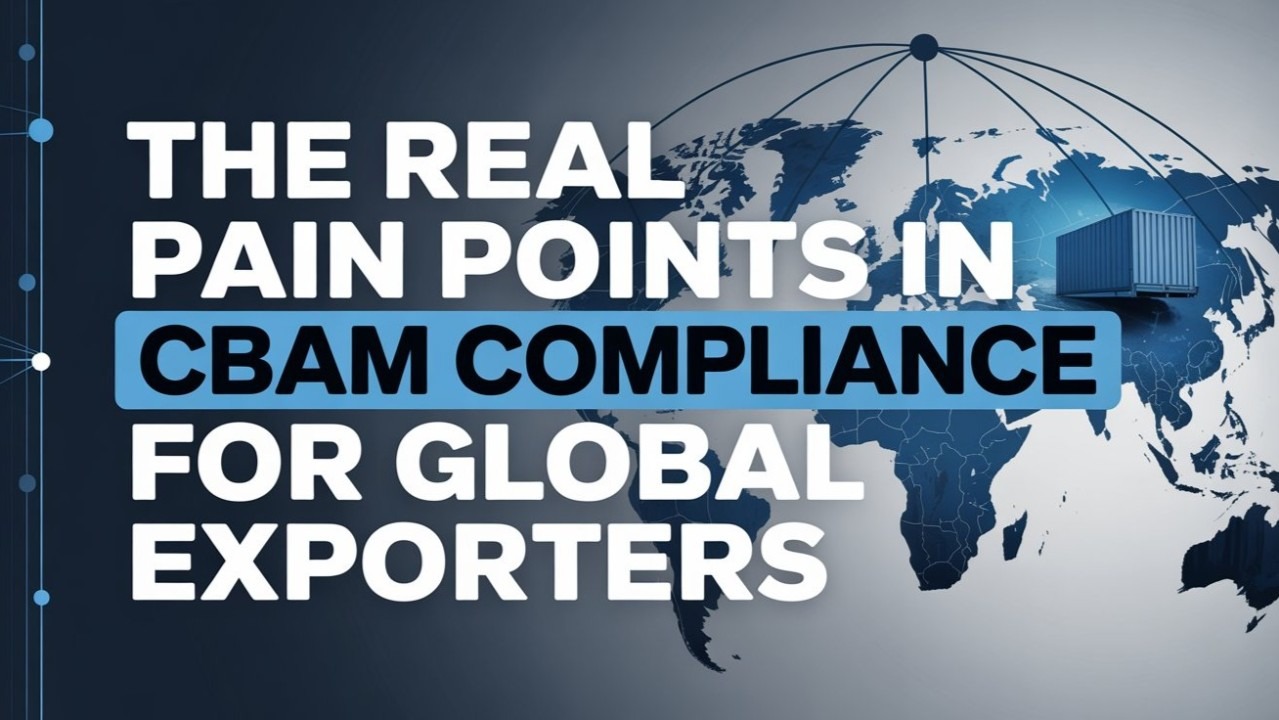
How the EU's ambitious climate policy is creating unprecedented compliance challenges for exporters worldwide
Ask any steel exporter in Mumbai, cement manufacturer in Istanbul, or aluminum producer in Shanghai about CBAM, and you'll get the same weary response: a long list of compliance struggles that multiply each quarter.
The European Union's Carbon Border Adjustment Mechanism isn't just another regulatory checkbox. It's a fundamental shift demanding exporters track, measure, and report carbon data with precision most have never attempted before.
The stakes are enormous. Europe is one of the world's largest single consumer market. CBAM compliance isn’t optional for EU market access—EU importers must report and (from 2026) pay, and exporters will increasingly be asked to provide verified emissions data to stay competitive.
But meeting these requirements is exposing painful gaps in how companies worldwide collect data, calculate emissions, verify information, and adapt to evolving rules. These aren't minor inconveniences. They're fundamental challenges reshaping how global exporters operate.
Pain Point 1: The Data Collection Nightmare
CBAM sounds simple on paper: report your emissions. In reality? It's a nightmare of fragmented information scattered across systems, suppliers, and geographies.
Here's the problem. The data exists in fragments, if it exists at all.
Energy bills show consumption but often miss carbon intensity factors. Supplier invoices list quantities and costs but rarely include emissions data. Production logs track output volumes but not the granular activity data needed for carbon calculations. Different departments maintain different datasets using incompatible formats and timeframes.
The fragmentation cascades through supply chains. When a steel mill in South Korea asks their limestone supplier for carbon data, that supplier often has no idea how to respond. They've never measured emissions because nobody asked before. The data gap multiplies across every tier of the value chain.
Geographic disparities compound the challenge. Countries like China, India, Turkey, Brazil, and most developing nations where carbon reporting hasn't been historically mandated lack the infrastructure for systematic data collection. Companies must build measurement systems from scratch while meeting current reporting deadlines.
It's like being asked to produce detailed financial statements when you've never kept formal accounts. Except you need to do it retroactively for the past year's production.
Pain Point 2: When Calculations Break Your Systems
Gathering fragmented data is hard enough. Actually calculating accurate emissions from that data? That's where most exporters hit a wall.
Carbon accounting isn't like financial accounting. Financial transactions follow standardized rules refined over centuries. Carbon accounting requires understanding industrial chemistry, energy systems, environmental science, and regional grid factors simultaneously.
Take aluminum production as an example. The carbon footprint varies dramatically based on multiple factors. Primary aluminum from electrolysis has entirely different emissions than secondary aluminum from recycled scrap. Even within primary production, electricity source matters enormously. Aluminum produced with hydropower in Norway has lower emissions of aluminum than from coal-powered facilities in other regions.
Transport emissions, processing emissions, and emissions from producing the carbon anodes used in electrolysis all contribute to the total. Calculating these accurately for thousands of product variations requires expertise most companies simply don't have.
CBAM allows multiple approaches for determining embedded emissions. In the first three reporting periods, importers could rely fully on default/estimated values when actual data was unavailable. From Q3 2024 onward, estimated values (including default values) are capped at 20% of total embedded emissions for complex goods, pushing companies toward installation-specific data. As CBAM moves into financial obligations from 2026, verification-ready, auditable emissions data becomes increasingly critical.
Most exporters started with Excel spreadsheets. This works for small volumes but collapses at scale. Formula errors propagate across thousands of rows. Different people make different assumptions about methodology. Version control becomes impossible when multiple teams work on the same datasets. Audit trails disappear.
The complexity multiplies for products crossing multiple borders during production. These aren't theoretical questions. They're daily operational challenges that most compliance teams lack the expertise to answer confidently.
Pain Point 3: The Verification Black Hole
Here's the uncomfortable question keeping compliance officers awake: How do you verify that carbon data is actually accurate when verification infrastructure is uneven and still developing outside Europe?
CBAM is built on assumptions of transparency and verifiability. Reported emissions should be measurable, documented, and auditable. But this assumption collides with reality in most exporting countries.
In financial accounting, verification systems are mature. Independent auditors examine records using established standards. Professional certifications are globally recognized. Legal frameworks establish accountability. Decades of practice refined these methods.
Carbon accounting verification outside Europe? It's in its infancy.
When a German buyer asks a Vietnamese steel exporter to verify emissions data, practical questions arise. What documentation counts as sufficient? Which measurement standards should apply? Who can credibly perform independent verification? What does "independent verification" actually mean in countries without established carbon auditing frameworks?
Many exporters provide emissions estimates based on industry averages, engineering calculations, or supplier-provided data that itself lacks verification. European importers accept this data because they have limited alternatives. But everyone involved understands the significant uncertainty in reported figures.
Supply chain visibility creates additional challenges. A cement manufacturer in Thailand reports emissions that should theoretically include limestone mining, fuel production, and electricity generation. But the cement manufacturer has limited visibility into supplier operations. They rely on data from suppliers who may lack measurement capability themselves.
As CBAM transitions to financial obligations in January 2026, uncertainty becomes financial risk. Underreporting emissions could trigger penalties. Overreporting results in unnecessarily higher costs. The absence of credible verification leaves companies exposed.
This verification gap isn't just a compliance problem. It's an integrity problem that undermines CBAM's entire purpose. If reported emissions can't be reliably verified, the carbon price signal gets distorted. Competitive advantage goes to those willing to underreport rather than those actually operating cleanly. The mechanism fails to achieve its climate objectives.
Pain Point 4: Chasing Regulatory Goalposts That Keep Moving
Just when exporters figure out compliance requirements, the rules change. This regulatory dynamism is exhausting companies worldwide.
Since October 2023, the European Commission has issued multiple updates to reporting templates, calculation methodologies, and data field requirements. Each update aims to clarify ambiguities and improve the system. But each also forces exporters to revise processes, retrain staff, modify IT systems, and communicate changes throughout their organizations.
Key methodological issues still lack clear guidance. How should companies allocate emissions across co-products from the same production process? How should they handle intermediate products that undergo substantial transformation? What level of granularity is required for different product categories?
The guidance on these questions continues evolving as regulators learn from transition period data.
Critical aspects of full implementation beginning in 2026 remain undefined. What will CBAM certificate prices be? How will verification be enforced? What penalties will apply for non-compliance or reporting errors? Will default values be updated to reflect technological improvements?
These unanswered questions create strategic paralysis. Should exporters invest now in capabilities for full implementation, or wait for regulatory clarity and risk being unprepared? Should they adopt automated systems that may need redesign as requirements evolve, or stick with flexible manual processes that don't scale?
There are no easy answers when the goalposts keep moving.
For large exporters with diverse product portfolios, each regulatory update triggers hundreds of hours of compliance work. Resources spent on regulatory adaptation can't be invested in production improvements, product development, or market expansion.
Smaller exporters face even greater challenges. They lack the compliance departments and specialized expertise that larger companies deploy. Regulatory changes that large organizations absorb as operational overhead can overwhelm smaller exporters' limited administrative capacity, potentially forcing them out of the European market entirely.
The Competitive Divide Taking Shape
These four challenges aren't affecting all exporters equally. They're creating a two-tier system reshaping competitive dynamics in global trade.
Large, sophisticated exporters with resources to invest in carbon measurement systems, data infrastructure, and compliance expertise are managing CBAM requirements, albeit painfully. They're building capabilities that, once established, create barriers to entry for smaller competitors.
Smaller exporters struggling with compliance face declining European market access, potentially exiting sectors where they previously competed successfully. Geographic advantages are emerging too. Exporters in countries with developing carbon accounting infrastructure gain ground. Those in nations without these systems start from further behind.
The competitive implications extend to product positioning. Exporters who can demonstrate lower carbon intensity through credible measurement gain pricing power and customer preference. Those relying on default values or unable to verify emissions data face disadvantages even if their actual operations are relatively clean.
CBAM is essentially creating a new form of competitive advantage based on carbon transparency capability. The winners won't necessarily be the cleanest producers, but rather those who can credibly demonstrate and document their carbon performance while managing compliance complexity efficiently.
Some exporters are already losing European customers not because their products are high-carbon, but because they can't provide the data and documentation CBAM requires. Carbon transparency is becoming as important as product quality and price.
Building Capabilities for What's Coming Next
The challenges exporters face with CBAM aren't temporary compliance burdens that will disappear once systems mature. They're revealing fundamental gaps in how global commerce tracks and communicates environmental data.
CBAM isn't an isolated European requirement. It's the beginning of carbon-transparent global trade. The UK is developing similar border adjustments. Other developed economies are watching closely and will likely follow.
Exporters need to build capabilities across four dimensions:
Technology infrastructure including automated data collection systems, integrated calculation platforms, real-time monitoring capabilities, and supplier collaboration tools. Manual spreadsheet processes won't scale to meet growing requirements.
Internal expertise in carbon accounting, verification protocols, regulatory interpretation, and supply chain data management. Companies can't outsource strategic capability entirely.
Supplier partnerships that cascade transparency requirements through value chains, provide measurement support, and create collaborative data systems with mutual accountability.
Strategic positioning that treats carbon transparency as core business capability, not peripheral compliance function. The companies building robust measurement and reporting systems today are preparing for the future of global trade.
Companies treating CBAM as temporary European compliance are missing the bigger picture. Those investing in carbon transparency capabilities are positioning for advantage as requirements spread globally and tighten over time.
The question isn't whether carbon transparency becomes standard in international trade. The question is whether your company builds these capabilities proactively or scrambles reactively as requirements multiply.
The Reality Check
These pain points are real, substantial, and not disappearing. Fragmented data collection, calculation complexity, verification gaps, and regulatory dynamism will persist as CBAM matures, and similar mechanisms emerge globally.
But they're also solvable with strategic investment and the right approach.
Digital platforms purpose-built for carbon compliance can address data fragmentation through integrated collection, calculation complexity through automated engines with built-in methodologies, and regulatory changes through flexible architectures designed for evolution.
What's required is treating carbon data with the same rigor and systematic approach that companies apply to financial data. This means investing in technology that makes measurement and reporting manageable, building expertise that bridges operations and regulations, developing supplier programs that extend transparency through value chains, and creating systems designed to adapt as requirements mature.
CBAM compliance is painful because it forces fundamental change in how companies track and communicate environmental performance. But this change is inevitable. The physics of climate change and the politics of carbon pricing guarantee that carbon transparency requirements will only intensify.
The exporters investing strategically now will gain advantages extending far beyond European market access. They'll be ready when other markets adopt similar requirements. They'll attract sustainability-focused customers. They'll operate more efficiently through better data visibility. They'll build competitive moats based on verified carbon performance.
The choice isn't whether to build these capabilities. It's whether to build them now with strategic intent or later under regulatory pressure with competitors already ahead.
WOCE provides comprehensive ESG and carbon management solutions with a CBAM module addressing data fragmentation, calculation automation, supplier transparency, and regulatory adaptation. Our platform esgpro.ai helps global exporters build the carbon accounting capabilities that will define success in tomorrow's trade environment. Contact us at contact@worldofcirculareconomy.com to start your carbon transparency journey.