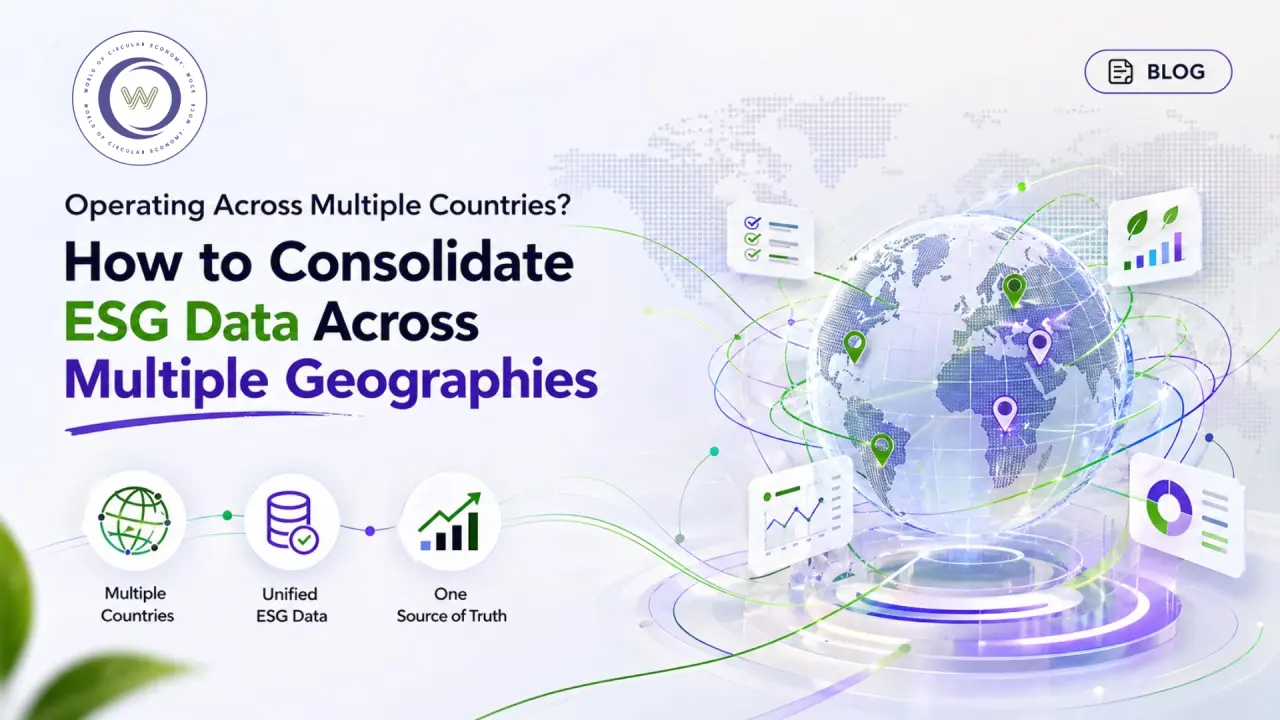
Operating Across Multiple Countries?

  • Operating Across Multiple Countries?

    How to Consolidate ESG Data Across Multiple Geographies

    Operating Across Multiple Countries?

    For global enterprises, ESG reporting sounds simple in theory.


    Measure. Report. Disclose.


    But the moment you operate across multiple countries, that simplicity disappears.


    What you are left with is not a reporting process.  It is a coordination challenge across geographies, teams, systems, and regulations.


    And most organizations underestimate just how complex this gets.


    The Reality No One Talks About


    At the headquarters level, ESG dashboards look clean.


    At the ground level, it is a completely different story.


    Data sits in:


    • Local spreadsheets


    • Plant-level systems


    • Emails and manual trackers


    • Vendor submissions in inconsistent formats


    Each geography operates differently.  Each team interprets ESG metrics slightly differently.  Each regulation demands something different.


    And yet, at the end of the quarter, everything is expected to come together into one clean report.


    That gap between expectation and reality is where most ESG challenges live.


    The Multi-Geography Problem Is Not Data. It Is Alignment.


    Most companies assume they have a data problem.


    In reality, they have an alignment problem.


    • Different countries follow different reporting standards


    • Different teams use different definitions


    • Different suppliers provide different levels of detail


    So even when data exists, it cannot be combined easily.


    One region reports emissions based on one methodology.  Another uses a different baseline.  A third is still estimating.


    Try consolidating that, and what you get is not insight.  You get confusion.


    Why This Is Becoming a Business Risk


    Earlier, this level of inconsistency was manageable.


    Now, it is not.


    Because ESG is no longer just internal reporting.


    It is being used for:


    • Regulatory filings


    • Investor disclosures


    • Customer requirements


    • Cross-border trade compliance


    Which means inaccuracies are no longer internal inefficiencies.  They are external risks.


    A mismatch in data across regions can lead to:


    • Compliance gaps


    • Audit challenges


    • Loss of credibility


    • Financial implications


    And in some cases, loss of business.

    The Shift from Reporting to Systems Thinking

    he mistake many enterprises make is treating ESG as a reporting layer.


    It is not.


    It is a data system problem.


    You cannot fix multi-geography ESG challenges by adding more people or more spreadsheets.


    You fix it by building a system where:


    • Data is collected in a consistent format


    • Definitions are standardized across regions


    • Inputs are validated at the source


    • Outputs are aligned with multiple frameworks


    In other words, ESG needs to be treated like finance.


    Structured. Standardized. System-driven.


    Standardization: The Non-Negotiable First Step


    Before technology, before dashboards, before automation, comes one thing:


    Standardization.


    If your Europe team defines emissions differently from your India team, no tool can fix that.


    Enterprises need to establish:


    • A common set of ESG metrics


    • Uniform calculation methodologies


    • Clear data ownership across regions


    This sounds basic.  It is not.


    Because this is where most organizations struggle.


    But without this, consolidation is just aggregation of inconsistent data.


    Why Spreadsheets Fail at Scale


    Spreadsheets are comfortable.  They are flexible.  They are familiar.


    And they are completely inadequate for multi-geography ESG reporting.


    Because:


    • There is no real-time visibility


    • Version control becomes a nightmare


    • Data validation is manual


    • Scaling across regions is inefficient


    At a small scale, this is manageable.  At enterprise scale, it breaks.


    And when it breaks, it does so silently.


    The Role of Technology in Consolidation

    Once standardization is in place, technology becomes the enabler.


    A centralized ESG platform changes the equation.


    It allows organizations to:


    • Integrate data from multiple geographies into one system


    • Apply consistent methodologies automatically


    • Validate data before it reaches reporting stage


    • Align outputs with multiple regulatory frameworks


    Most importantly, it creates a single source of truth.


    No more version conflicts.  No more last-minute data chasing.  No more uncertainty before submission deadlines.


    The Overlooked Challenge: Supply Chain Data


    Even if internal data is sorted, one major challenge remains.


    Suppliers.


    In global operations, a significant portion of ESG data sits outside the organization.


    And suppliers are:


    • Spread across geographies


    • At different maturity levels


    • Often unprepared for ESG reporting


    This is where most ESG strategies break down.


    Because you cannot consolidate what you cannot collect.


    Enterprises need structured mechanisms to:


    • Engage suppliers


    • Standardize data requests


    • Track submissions


    • Validate inputs


    Without this, ESG reporting will always remain incomplete.


    What Good Looks Like


    When ESG data is truly consolidated, the shift is visible.


    Leadership stops asking for numbers.  They start asking questions.


    • Which geography is underperforming?


    • Where are emissions intensity trends improving?


    • Which suppliers are creating risk?


    At this stage, ESG is no longer a compliance function.


    It becomes a decision-making tool.


    The Competitive Advantage No One Mentions


    Most companies look at ESG consolidation as a cost.


    Few see it as an advantage.


    But the ones who get this right:


    • Respond faster to regulatory changes


    • Build stronger investor confidence


    • Improve operational efficiency


    • Win business where ESG is a differentiator


    Because in a world moving toward mandatory disclosure,  clarity is power.

    Closing Thought


    Operating across multiple countries will always bring complexity.


    That is not the problem.


    The problem is trying to manage that complexity without structure.


    ESG reporting is moving toward a world where data needs to be:


    Consistent.  Comparable.  Verifiable.


    The companies that build for this now will not just stay compliant.


    They will stay ahead.


    For enterprises looking to simplify ESG data consolidation across geographies and build a scalable reporting system, contact WOCE at contact@worldofcirculareconomy.com.