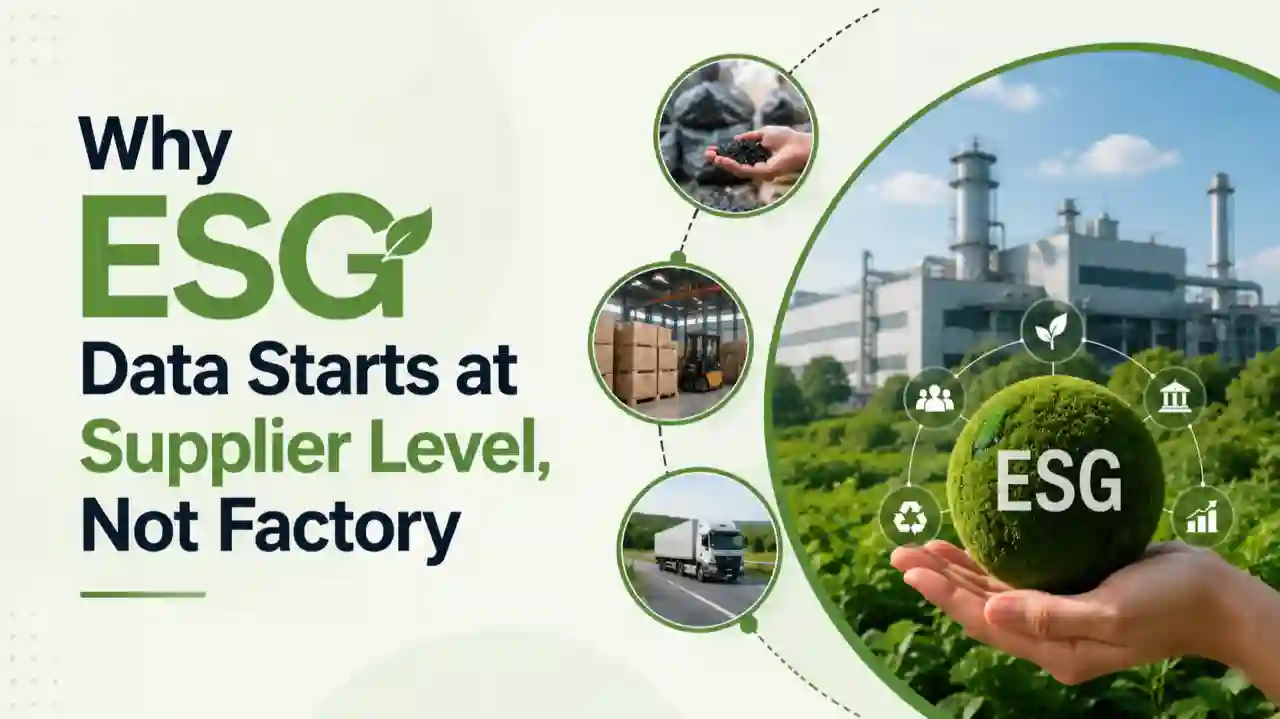
Why ESG Data Starts at Supplier Level, Not Factory

  • Why ESG Data Starts at Supplier Level, Not Factory

    Why ESG Data Starts at Supplier Level, Not Factory

    For most organizations, ESG data architecture is designed around the factory.


    Data is captured at the point of production. Emissions are calculated based on fuel consumption, electricity usage, and process-level inputs. Reporting systems are built to aggregate this data into plant-level and enterprise-level disclosures.


    This approach works for Scope 1 and Scope 2.


    It breaks down the moment Scope 3 becomes material.


    The Structural Limitation of Factory-Centric ESG Systems


    Factory-level ESG systems are inherently boundary-limited.


    They are designed to capture:


    • Direct emissions from owned or controlled assets


    • Indirect emissions from purchased energy


    • Operational efficiency metrics

    What they are not designed to capture is embedded carbon.

    Embedded emissions originate in upstream processes such as:


    • Raw material extraction


    • Intermediate processing


    • Component manufacturing


    • Third-party logistics


    These emissions are not observable within the factory boundary. They are transferred into the system through procurement.


    This creates a structural blind spot.


    Even if factory-level data is perfectly measured, it does not represent the full emissions profile of the product or the organization.


    Scope 3 Is a Data Architecture Problem


    Scope 3 is often treated as a measurement problem.


    In reality, it is a data architecture problem.


    The challenge is not just calculating emissions.


    It is acquiring granular, supplier-specific activity data at scale.


    Most organizations default to:


    • Industry-average emission factors


    • Spend-based estimations


    • Secondary datasets


    These methods provide directional estimates, but they fail under:


    • Product-level reporting requirements


    • Audit scrutiny


    • Regulatory disclosures


    As frameworks evolve toward primary data expectations, reliance on proxies becomes a limitation.


    This is where supplier-level data becomes critical.
     

    The Fragmentation Problem in Supplier Data

    Supplier ecosystems are not standardized data environments.


    Each supplier operates with:


    • Different measurement methodologies


    • Different system maturity levels


    • Different reporting frequencies


    • Different interpretations of ESG metrics


    For example:


    One supplier may report emissions based on energy consumption.


    Another may use production-based intensity metrics.


    A third may provide only aggregated annual data.


    From a data integration perspective, this creates:


    • Non-comparable datasets


    • Inconsistent system boundaries


    • Misaligned emission factors


    Without normalization, aggregation of such data leads to analytical distortion, not insight.


    Why Factory-Level Optimization Does Not Translate to System-Level Impact


    A common failure mode in ESG strategy is optimizing within the factory boundary while ignoring upstream variance.


    Consider a scenario:


    • A company reduces Scope 1 emissions by improving kiln efficiency


    • At the same time, it shifts to a supplier with higher embodied carbon in raw materials


    From a factory perspective, emissions improve.


    From a system perspective, emissions may increase.


    This is the core limitation of factory-centric models.


    They optimize controlled variables, but ignore imported emissions.


    Without supplier-level data, this trade-off remains invisible.


    Regulatory Direction Is Forcing Upstream Transparency


    Global ESG frameworks are moving toward value chain-level disclosure.


    This includes:


    • Product-level carbon accounting


    • Supply chain traceability


    • Verified primary data requirements


    Mechanisms such as carbon border adjustments and sector-specific regulations are increasing the need for:


    • Audit-ready emissions data


    • Methodology consistency


    • Traceability to source


    In this context, supplier data is no longer optional.


    It is becoming a prerequisite for compliance.

    From Data Collection to Data Infrastructure

    Collecting supplier data is not the end objective.


    The real requirement is to build supplier-integrated ESG data infrastructure.


    This involves:


    1. Standardized Data Models


    Defining uniform templates for:


    • Activity data


    • Emission factors


    • System boundaries


    2. Methodology Alignment


    Ensuring suppliers calculate emissions using:


    • Consistent protocols


    • Comparable baselines


    3. Data Validation Layers


    Implementing checks for:


    • Completeness


    • Consistency


    • Outlier detection


    4. System Integration


    Connecting supplier inputs into a centralized platform that enables:


    • Real-time visibility


    • Version control


    • Audit traceability


    Without these layers, supplier data remains fragmented and unusable.


    The Shift from Reporting Systems to Decision Systems


    When supplier-level data is structured and integrated, ESG systems evolve.


    They move from:


    Reporting systems


    to


    Decision systems


    Organizations gain the ability to:


    • Benchmark suppliers on emission intensity


    • Identify high-impact intervention points


    • Model reduction scenarios across the value chain


    • Align procurement decisions with carbon outcomes


    This is where ESG begins to influence business strategy.


    Conclusion


    ESG data does not start at the factory because emissions do not start at the factory.


    They accumulate across the value chain.


    A factory-centric ESG system captures only the final layer of that accumulation.


    To build accurate, decision-grade ESG systems, organizations need to move upstream and treat supplier data as foundational, not supplementary.


    Because in a system where emissions are embedded, transferred, and transformed across multiple tiers, visibility at the source determines the quality of every downstream decision.


    For organizations looking to build supplier-integrated ESG data systems and move from estimation to primary data-driven reporting,


    Contact WOCE at contact@worldofcirculareconomy.com