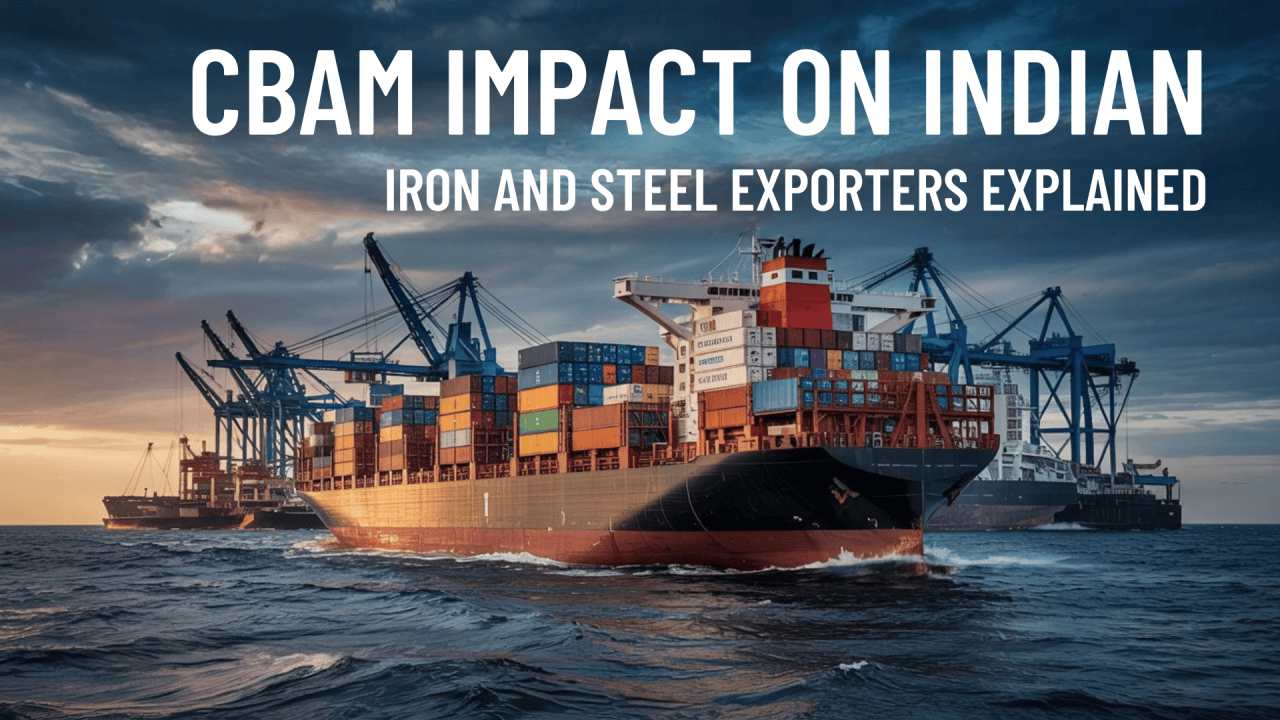
CBAM Impact on Indian Iron and Steel Exporters Explained
: A 2026 Deep Dive

As we navigate January 2026, Indian steel exporters are grappling with the full brunt of the EU's Carbon Border Adjustment Mechanism (CBAM), which entered its definitive phase on January 1st. Picture this: A shipment of hot-rolled coils from Mumbai to Rotterdam now incurs a carbon levy that could slash profit margins by 15-22%, forcing exporters to discount prices just to stay competitive. This isn't hypothetical anymore; exports of steel and Iron to the EU have already tumbled 24.4% in FY25, and with CBAM's tax phase in full swing, the sector faces a "double hit" of higher tariffs and compliance costs. (Source: GTRI)
This blog delves into advanced economic modeling, real-time 2026 scenarios, company strategies, and policy maneuvers. We'll explore how CBAM is reshaping India's steel industry, blending data-driven insights with forward-looking opportunities.
Decoding CBAM: Mechanics and 2026 Enforcement
CBAM, embedded in the EU's Fit for 55 package, targets carbon leakage by pricing embedded emissions in imports. For iron and steel, it covers direct and indirect embedded emissions, calculated via a default methodology unless exporters provide verified data.
In practice, Indian exporters must register on the CBAM Transitional Registry, submit quarterly reports, and purchase certificates. Penalties differ by phase and Member State: during the transitional period they are commonly cited as €10–€50/t of unreported emissions, while under the definitive regime penalties for insufficient certificate surrender are generally described as €100/t, with surrender obligations starting 2027.
Current 2026 scenario: As of January 27th, initial data shows Indian steel volumes to the EU down 35.1% YoY, with MSMEs hit hardest due to documentation burdens.
Economic Ripples: Advanced Modeling and 2026 Realities
Leveraging Computable General Equilibrium (CGE) models, CBAM's impact transcends simple tariffs. A CSEP analysis projects a 0.2% GDP dent for exposed exports, but for steel—90% of CBAM-affected goods—the sectoral shock is amplified. Employment in steel, supporting 2.5 million jobs, could contract 5-10% if unmitigated, per distributional implications. (Data sourced from GTRI and Jefferies)
In 2026, with ETS prices rising, mid-sized exporters (50,000 tons/year) face €500k-€1.2M annual costs, eroding competitiveness against low-emission rivals like South Korea. Jefferies forecasts 6-9% volume CAGR for Indian majors like Tata and JSW through 2028 but assumes HRC prices rebound to ₹54k/t from ₹48.5k spot, offsetting CBAM via domestic safeguards.
Real-time pain points: Exporters are slashing prices to cover importers' taxes, while compliance—emissions auditing and verification—adds 2-5% overhead. Odisha's steel hubs, like those from Tata and JSW, report mixed fortunes: Domestic demand booms, but EU routes suffer.
Geopolitical and Operational Challenges in 2026
India views CBAM as a WTO-violative barrier, arguing it discriminates against developing nations without common-but-differentiated responsibilities. In ongoing India-EU FTA talks—slated for signing this month—India demands "mutual recognition" of green standards to waive CBAM, but the EU has rejected exemptions, insisting on verified low-carbon compliance. Without relief, engineering exports could fall by 10%, per EEPC. FTA perks like scrap import relief could aid EAF transitions, cutting emissions 60-70%, but agriculture carve-outs complicate negotiations.
Operationally, coal's dominance persists, but 2026 catalysts include India's nascent carbon market for "hard-to-abate" sectors like steel, notified to align with CBAM and decouple growth from emissions. Supply chain greening is urgent: Foreign spares retain edges, and non-tariff barriers like certifications compound costs. Competitors? Turkey's EAF-heavy production undercuts India, while China's dominance in CBAM volumes pressures global spreads.
Strategic Opportunities: Green Pivots and 2026 Innovations

Amid headwinds, CBAM accelerates decarbonization. Tata Steel's net-zero 2050 roadmap includes hydrogen DRI pilots, while JSW invests in carbon capture. Graphite electrode firms like HEG benefit from EAF shifts, with stocks surging CBAM-driven demand.
Government levers: A domestic carbon tax could offset CBAM via credits, while subsidies for R&D and green banks fund transitions. Diversification to ASEAN/Middle East mitigates EU dependency, and FTA-enabled Mode 4 visas boost services offsets.
Forging Ahead: 2026 Imperatives for Indian Steel
In this pivotal year, CBAM isn't just a tax; it's a structural shift demanding agility. With FTA announcements looming and carbon markets evolving, Indian exporters must audit, innovate, and advocate. For WOCE stakeholders, the equation is clear: Invest in green premiums now to capture premiums later. As Jefferies bullishly notes, resilient players like Tata could thrive. The path to net-zero 2070 starts here—turn CBAM's pressure into India's green steel forge.