ESG Software Isn't the Problem. Your Data Is

Over the last few years, organizations across industries have invested heavily in ESG software. Reporting platforms have multiplied, dashboards have become sophisticated, and sustainability teams now have more technology at their disposal than ever before.
Yet the same challenges persist. Missed reporting deadlines. Supplier data that never arrives. Emissions calculations that don't add up. Compliance gaps that surface at the worst possible time.
If ESG software has become this advanced, why do the problems remain?
Because most organizations are solving the wrong problem.
The Misconception Slowing Everyone Down
Companies assume their challenge is reporting. In reality, their challenge is data.
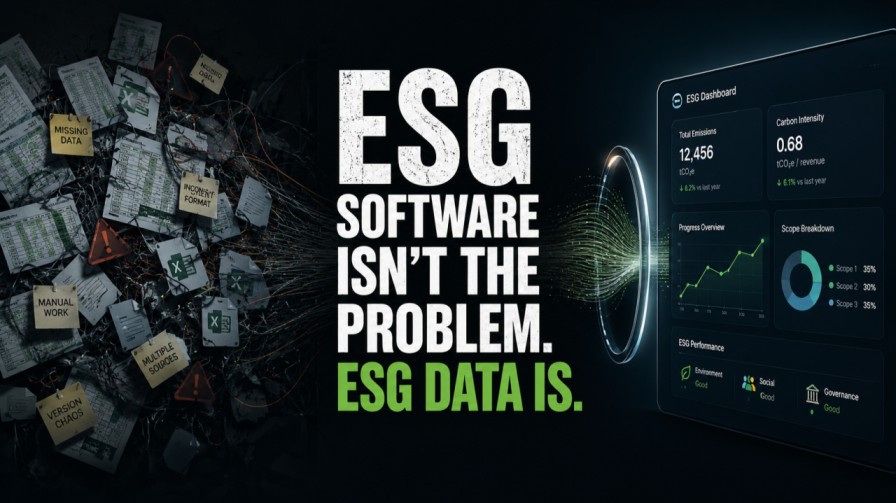
By the time an ESG report is being prepared, the real complexity has already happened. Data has been pulled from multiple business units. Suppliers have been chased repeatedly. Spreadsheets have traveled back and forth across departments. Sustainability teams have spent weeks validating numbers that may or may not be accurate.
The reporting platform is often just the final step in a long, fragmented process.
The actual problem starts much earlier.
Where ESG Data Actually Comes From
Unlike financial data, ESG data is never generated in one place. It originates across the entire organization and often extends well beyond it.
Energy consumption comes from facilities teams. Supplier emissions require inputs from hundreds of vendors operating across different geographies. Procurement data lives in one system. Operational data lives in another. Scope 3 emissions require information from supply chain partners who may have never measured their carbon footprint before.
Each source has its own format, timeline, and level of reliability.
The result? Sustainability teams managing a sprawling ecosystem of spreadsheets, emails, PDFs, and disconnected databases. The challenge isn't writing the report. The challenge is assembling credible, consistent information from sources that were never designed to work together.
Why Most Software Doesn't Fix This
When reporting gets difficult, the instinct is to find better software. Understandable, but insufficient.
A sophisticated platform can organize information, generate dashboards, and streamline disclosures. What it cannot do is improve the quality of incomplete supplier responses, standardize inconsistent datasets, or create visibility where no data exists in the first place.
Software works with what it receives. That's the hard limit.
If supplier data is missing, reporting stays difficult.
If emissions data is inconsistent, reporting stays unreliable.
If business units operate in silos, visibility stays limited.
This is why organizations continue to face the same ESG challenges even after implementing new tools. The tool wasn't the bottleneck. The data was.
The Credibility Problem Is Getting Bigger
As ESG moves from voluntary reporting to regulatory compliance, the stakes around data quality are rising fast.
Frameworks like CBAM, BRSR, and emerging carbon market mechanisms are no longer just asking whether organizations report ESG information. They are asking whether that information can be verified, traced, and trusted.
This is a fundamentally different question. And many organizations are not ready for it.
Companies that cannot demonstrate the reliability of their underlying data face real consequences: compliance risk, investor scrutiny, strained customer relationships, and supply chain friction. Data quality is no longer an administrative concern. It is a strategic business capability.
From Reporting Exercise to ESG Intelligence
The organizations ahead of this curve are rethinking ESG from the ground up.
Instead of treating it as an annual reporting exercise, they are building systems that provide continuous visibility into sustainability performance. The goal is no longer simply to publish a report. The goal is to create infrastructure that supports smarter decisions throughout the year.
That means standardizing how data is collected, making supplier engagement systematic rather than reactive, embedding validation into workflows rather than applying it at deadline time, and creating centralized visibility across every ESG dataset.
When this infrastructure exists, ESG becomes operational intelligence. Leaders can see emissions hotspots before they become compliance issues. Procurement teams understand supplier risk before it becomes a liability. Management makes long-term decisions with real sustainability data, not estimates assembled under pressure.
The conversation shifts from reporting what happened to managing what's happening.
Building the Right Foundation
Reliable ESG reporting starts with reliable ESG data systems. There is no shortcut around this.
Organizations need structured processes for collecting information across operations and supply chains. Validation needs to happen continuously, not just before reporting deadlines. Supplier engagement needs to be built into workflows, not triggered by panic emails every quarter.
This is where ESG technology genuinely delivers value. Not as a reporting layer applied on top of chaos, but as infrastructure that improves how data is collected, validated, and managed from the start.
Platforms like esgpro․ai are helping organizations move beyond fragmented spreadsheets and manual workflows, building structured approaches to ESG data management that make reporting faster, more accurate, and audit-ready. The result isn't just a better report. It's a better understanding of where the business actually stands on sustainability.
The Bottom Line
Most organizations don't have an ESG reporting problem. They have an ESG data problem.
The spreadsheets, supplier follow-ups, and manual validation processes that exist behind the scenes are the real barriers. Reporting software matters, but it's only as good as the data flowing into it.
As ESG requirements continue to evolve, the organizations that invest in stronger data foundations will pull ahead. Not just on compliance, but on credibility, efficiency, and the ability to make sustainability a genuine business advantage.
The future of ESG won't be defined by reporting tools alone. It will be defined by the quality of the data powering them.
Looking to move from fragmented ESG data to audit-ready intelligence? esgpro․ai by WOCE helps organizations build the data infrastructure that modern ESG reporting demands. Contact us at contact@worldofcirculareconomy.com